
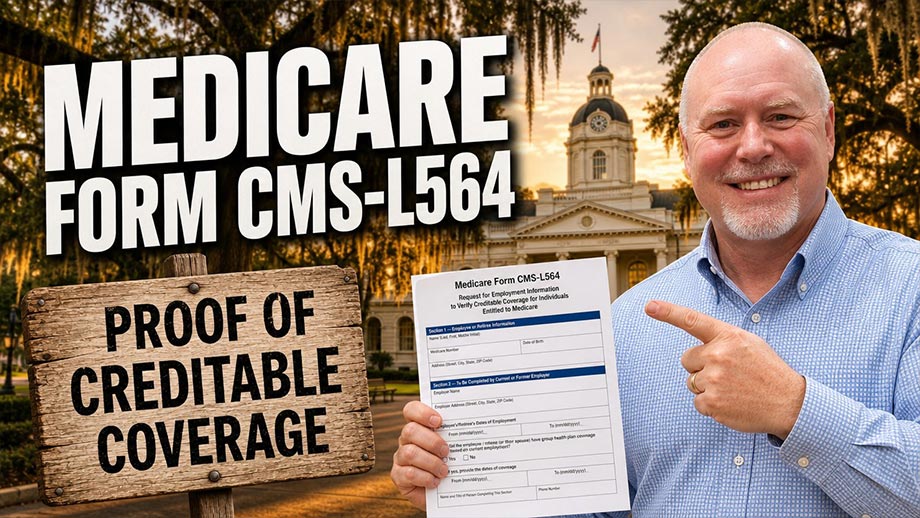
Direct answer: Form CMS-L564, “Request for Employment Information,” is how you prove you had qualifying employer group health coverage when enrolling in Medicare during a Special Enrollment Period (SEP) — the path available if you or your spouse delayed Medicare because of active employer coverage. It must be submitted together with your actual Part B enrollment application, Form CMS-40B, not on its own. Getting this pairing and the documentation right the first time is what keeps your enrollment from stalling or triggering a late penalty you shouldn’t owe.
How Does Delayed Medicare Enrollment Actually Work?
When you first become eligible for Medicare, typically at 65, you have a seven-month Initial Enrollment Period (IEP) — the month you turn 65, plus three months before and three months after.
Missing that window generally pushes you into the General Enrollment Period (GEP), an annual fallback that can carry a late enrollment penalty. But if you or your spouse are still actively working and covered by a qualifying employer group health plan, you may be able to delay Medicare without penalty and use a Special Enrollment Period once that coverage ends instead.
Who Is Eligible to Use Form CMS-L564?
You need to meet several criteria together:
How Do I Get Form CMS-L564?
You can download it directly from CMS’s website, request a copy by calling Social Security, or pick one up in person at your local Social Security office. Confirm you’re using the most current version of the form before filling it out, since using an outdated version can cause processing delays.
The form has three sections:
Section A — Worker Information: your Social Security number, full legal name, birth date, phone number, and current address.
Section B — Employer Information: your employer’s legal name and address, confirmation of group health plan coverage, and the specific start and end dates of that coverage. Precision on the dates matters — your coverage needs to be verified as continuous from the first month you were eligible for Medicare Part B through when it ended, so incomplete or vague date ranges can cause real delays.
Section C — Employer Acknowledgment: a signature from an authorized company representative, the date signed, their title, and a contact phone number.
What Documentation Do I Need to Submit With the Form?
To avoid delays, include:
Make sure every document clearly shows your name and matches the dates on the form itself — mismatches between documents are a common, avoidable cause of processing delays.
How and Where Do I Submit Form CMS-L564?
This is a detail the process gets wrong often enough to call out clearly: Form CMS-L564 must be submitted together with Form CMS-40B, your actual Application for Enrollment in Medicare Part B — not on its own. Submitting the L564 alone without the 40B doesn’t complete your enrollment.
What If My Employer Won’t Complete Section B?
First, try to understand why — it’s often simply unfamiliarity with the form’s purpose, which can be resolved by explaining it’s required for your Medicare Part B enrollment waiver. If your employer remains unwilling to cooperate, contact the Social Security Administration directly for guidance on alternative documentation that may be accepted instead, such as W-2 forms, pay stubs, or health insurance cards showing your coverage.
If you discover an error after submission, contact the SSA to retrieve the form, correct the error in ink with your initials next to the change, and resubmit promptly.
Bottom Line
Form CMS-L564 exists to prove you had qualifying employer coverage so you can enroll in Medicare through a Special Enrollment Period without a late penalty — but it only works when submitted correctly, paired with your CMS-40B application, with accurate dates that match your supporting documentation. Getting this right the first time avoids the delays and resubmissions that can otherwise eat into your SEP window. Keep a copy of everything you submit, and don’t hesitate to follow up with your local Social Security office if you haven’t heard back within a reasonable time.
Key Takeaways
What is Form CMS-L564 used for?
Proving you had qualifying employer group health coverage, so you can enroll in Medicare during a Special Enrollment Period without a late penalty.
Do I submit CMS-L564 by itself?
No. It must be submitted together with Form CMS-40B, your actual Medicare Part B enrollment application — submitting the L564 alone doesn’t complete your enrollment.
What if my employer refuses to fill out Section B?
Contact the Social Security Administration for guidance on alternative documentation, such as W-2 forms, pay stubs, or health insurance cards showing your coverage dates.
How long is my Special Enrollment Period?
Eight months, starting the month after your active employment or employer-based group health coverage ends, whichever happens first.
What happens if I miss my SEP?
You may need to wait for the next General Enrollment Period and could face a permanent late enrollment penalty added to your Part B premium.


Direct answer: Federal law excludes certain categories of drugs from standard Medicare Part D coverage — including cosmetic drugs, fertility drugs, drugs for sexual dysfunction, most over-the-counter medications, and weight-loss drugs when prescribed solely for weight loss. But “excluded” isn’t always absolute: many of these drugs become coverable when prescribed for a different, medically accepted purpose, and — notably — weight-loss GLP-1 medications now have a real, if temporary, path to Medicare coverage through a new federal program separate from standard Part D rules. Understanding both the exclusions and their exceptions matters more than just knowing the blanket rule.
Why Doesn’t Medicare Cover These Drug Categories?
Medicare’s Part D exclusions come from federal law, generally applying to medications considered not medically necessary, not used for a medically accepted indication, or historically viewed as addressing quality-of-life rather than medically essential needs. Part D plans can choose to cover some excluded drugs anyway, but without Medicare’s financial contribution toward that coverage — which typically means a higher plan premium to offset the added cost. Most plans stick to the standard exclusions specifically to keep premiums more competitive.
Barbiturates — sedative-hypnotics used for anesthesia, seizures, and insomnia. Generally excluded due to abuse potential, unless used to treat specific conditions like epilepsy, cancer, or a chronic mental health disorder.
Benzodiazepines — used for anxiety, muscle spasms, and seizures. Typically excluded, though coverage may apply when prescribed for conditions specifically recognized under Part D rules.
Cosmetic drugs — medications solely for cosmetic purposes, like treating wrinkles or promoting hair growth, since they aren’t considered medically necessary.
Fertility drugs — excluded because they aren’t classified as addressing an immediate health necessity, despite their genuine importance for reproductive care.
Drugs for sexual dysfunction — generally classified as quality-of-life treatments rather than medically necessary or life-sustaining ones.
Weight loss or weight gain drugs — excluded when prescribed solely for weight management, unless the underlying condition is itself a diagnosed medical necessity, such as hypothyroidism-related weight gain or morbid obesity meeting specific medical criteria. This category now has a significant, newsworthy exception — see below.
Yes, and this is a meaningful update if you’re working from older information. A new, temporary federal demonstration program now provides Medicare beneficiaries access to select GLP-1 medications specifically approved for weight management — including certain formulations of semaglutide and tirzepatide-based drugs — at a modest, fixed monthly copay, separate from standard Part D coverage rules.
This program operates outside the normal Part D benefit structure and is scheduled to run for a limited period rather than being a permanent coverage change. To participate, you generally need to be actively enrolled in a Part D or Medicare Advantage plan with drug coverage, and your provider needs to certify that the medication is being used as part of a broader program involving diet and lifestyle changes, not as a standalone prescription.
This is separate from, and in addition to, the pre-existing exception: GLP-1 drugs prescribed for an approved medical indication other than weight loss alone — Type 2 diabetes management, cardiovascular risk reduction in patients with existing heart disease, or moderate-to-severe obstructive sleep apnea — have generally already been coverable under standard Part D rules, subject to your specific plan’s formulary and any prior authorization requirements. If you don’t qualify for the new weight-loss-specific program, it’s worth checking whether you might already qualify for coverage under one of these existing indications instead.
Given how new and specific this program’s rules are, confirming your eligibility directly with your Part D plan or Medicare.gov is worth doing rather than assuming either the old “not covered” rule or the new program automatically applies to your situation.
What Other Categories Does Medicare Generally Exclude?
Over-the-counter medications. Standard OTC drugs — pain relievers, cold and flu medication, allergy medicine — aren’t covered under Part D, and reimbursement claims for them are typically denied unless prescribed by a provider as part of a specific Part B-covered service. OTC items are sometimes covered when tied to covered durable medical equipment, like supplies for a nebulizer.
Prescription vitamins and minerals. General-use multivitamins and supplements like vitamin E or C aren’t covered, with exceptions for things like prenatal vitamins or vitamin D analogs prescribed for a specific medical condition.
Non-FDA-approved drugs. Experimental drugs not yet approved for any use, and compounded drugs lacking FDA approval, generally aren’t covered. Checking a medication’s FDA approval status before assuming coverage is worth doing if you’re prescribed something unfamiliar.
What Exceptions Exist for a Medically Accepted Purpose?
Several categories that are excluded by default can become coverable when prescribed for a specific, medically accepted purpose:
Bottom Line
Medicare’s Part D exclusions aren’t as absolute as a simple “not covered” list suggests — many depend entirely on why a drug is being prescribed, not just what the drug is, and the weight-loss drug landscape specifically has shifted meaningfully with the new demonstration program. Checking your specific plan’s formulary, understanding the medical indication your prescription is tied to, and confirming eligibility for any newer programs directly, rather than relying on an older blanket assumption, is what actually determines your coverage. Your plan’s formulary can also change from year to year, so revisiting this during Annual Election Period matters even if nothing about your prescriptions has changed.
Key Takeaways
Does Medicare cover weight-loss drugs?
Not under standard Part D rules when prescribed solely for weight loss, but a new temporary federal demonstration program now provides access to select GLP-1 weight-loss medications at a modest copay, separate from standard rules — check your eligibility directly.
Does Medicare cover Ozempic or Wegovy?
It depends on why it’s prescribed. These may be covered under standard Part D rules for diabetes management or cardiovascular risk reduction, and Wegovy specifically may now also be accessible through the new weight-loss demonstration program if you meet its eligibility criteria.
Does Medicare cover over-the-counter medications?
Generally no, unless prescribed by a provider as part of a Part B-covered service, or tied to covered durable medical equipment.
Does Medicare cover vitamins?
Generally not general-use multivitamins or common supplements, with exceptions for things like prenatal vitamins or vitamin D analogs prescribed for a specific condition.
Can an excluded drug ever become covered?
Yes, if it’s prescribed for a different, medically accepted purpose than its default excluded use — coverage often depends on the reason for the prescription, not just the drug itself.
Where do I check if my specific medication is covered?
Your Part D plan’s formulary, which can vary between plans and change annually — always verify directly rather than relying on general exclusion rules.

Direct answer: An HMO (Health Maintenance Organization) Medicare Advantage plan requires you to choose a primary care provider from the plan’s network, get referrals from that PCP to see specialists, and generally stay within the network for routine care — going outside it means paying the full cost yourself, with one major exception: emergency and urgent care are covered anywhere in the United States, regardless of network. That exception matters more than most HMO overviews let on, and it comes with a real gotcha worth understanding before you need it.
What Role Does My Primary Care Provider Play?
Your PCP is your care coordinator and gatekeeper — the main point of contact for your medical needs, and the person who issues referrals when you need to see a specialist or obtain certain medical equipment. Building a real, ongoing relationship with your PCP genuinely helps here, since they’re the one navigating your care within the network on your behalf. You can typically change your assigned PCP if the relationship isn’t working, by contacting your plan directly — you’re not locked into your initial choice for the life of the policy.
What’s the Emergency and Urgent Care Exception, and Why Does It Matter?
This is the single most important exception to understand about HMO structure, and it’s federally required, not a plan-by-plan courtesy. Medicare Advantage HMO plans must cover emergency care and urgent care anywhere in the U.S., without requiring an in-network provider or a referral, and without additional restrictions.
Practically, this means if you’re traveling and break your arm, or your grandchild’s visit turns into a nasty flu that needs same-day attention, your HMO has to cover it, out-of-network or not.
Here’s what a lot of general HMO explainers leave out, and it’s a genuine trap: the emergency care exception covers stabilizing the emergency itself — it doesn’t automatically extend to follow-up care. If you’re hospitalized while traveling and the hospital refers you to a specialist for follow-up treatment, that specialist may be entirely out-of-network, and that follow-up visit can carry full out-of-network cost-sharing, even though the original emergency was covered without issue.
There is a real protection here worth knowing: your plan is generally required to cover medically necessary follow-up care connected to the emergency if delaying that care would endanger your health. But this isn’t automatic or unlimited — after you’re stabilized, you or your treating doctor are expected to contact your plan to coordinate next steps, and the plan may require its approval for additional services beyond the initial emergency stabilization.
What Happens If I’m a Snowbird or Travel Frequently?
This is where HMO structure genuinely limits you in a way worth planning around. Medicare Advantage HMO plans are approved on a county-by-county basis, and routine, non-emergency care outside your plan’s service area generally isn’t covered at all — only the emergency/urgent care exception applies. If you split time between two states, a routine doctor visit during your months away from home is likely to be an out-of-pocket bill in full, not a higher-cost-sharing situation the way it might be under a PPO.
If this describes your lifestyle, it’s worth seriously weighing an HMO against a PPO or Original Medicare with Medigap, both of which handle this situation very differently.
Two protections worth knowing:
Is There a Version of HMO With More Flexibility?
Yes — some plans, called HMO-POS (Point-of-Service), function like a standard HMO for most care but include a limited allowance to see out-of-network providers for certain services, generally at a higher cost. If HMO’s referral structure appeals to you but the strict no-out-of-network rule feels too rigid, it’s worth checking whether an HMO-POS option exists in your area.
HMO plans work best for people who genuinely stay local for their healthcare, don’t need frequent specialist access, and are comfortable with the referral process as a normal part of getting care. In exchange for these constraints, HMOs typically offer the lowest out-of-pocket costs among Medicare Advantage plan types — a real trade-off, not just a limitation.
Bottom Line
HMO plans deliver cost-effective, structured care for people whose healthcare needs and travel patterns fit within a defined network — but the nationwide emergency/urgent care exception, and its limits around follow-up care, are exactly the kind of detail that matters when something actually happens rather than when you’re comparing plans on paper. Understanding these mechanics before you need them — not while you’re standing in an out-of-state emergency room — is what actually protects you.
Key Takeaways
Does an HMO Medicare Advantage plan cover care when I’m traveling?
Only emergency and urgent care, which must be covered anywhere in the U.S. regardless of network. Routine, non-emergency care outside your service area generally isn’t covered.
Is follow-up care after an emergency automatically covered under an HMO?
Not automatically. The emergency itself is covered, but follow-up care from an out-of-network provider may require your plan’s coordination and approval, and could carry out-of-network cost-sharing without it.
Can I change my primary care provider under an HMO plan?
Yes, generally you can change your assigned PCP by contacting your plan directly if the relationship isn’t working for you.
Is an HMO a good fit for snowbirds or frequent travelers?
Generally not ideal, since routine care outside your plan’s service area typically isn’t covered. A PPO or Original Medicare with Medigap usually handles this situation better.
What is an HMO-POS plan?
A hybrid HMO structure that includes a limited allowance to see out-of-network providers for certain services, usually at a higher cost than staying in-network.
What happens if my provider leaves my HMO’s network while I’m in treatment?
Continued care protections may allow a limited window of continued in-network-rate care, though specifics vary — confirm directly with your plan if this happens.

Direct answer: Three trends once discussed as possibilities are confirmed realities: federal prior authorization reform has been finalized with real enforcement teeth, out-of-pocket costs and benefit variability continue to catch enrollees off guard, and several major insurers are actively narrowing their footprint or exiting less profitable markets. None of this means Medicare Advantage is failing as a program — enrollment continues to grow — but it does mean the coverage landscape looks meaningfully different than it did even a few of years ago, and treating your current plan as a fixed, unchanging thing is a mistake.
Change 1: Prior Authorization Reform Has Actually Happened
This is the most concrete update. CMS finalized a rule fundamentally reshaping how prior authorization works in Medicare Advantage, and the specifics are real, not aspirational:
Why this matters in scale: recent federal data found Medicare Advantage insurers made over 52 million prior authorization determinations in a single year, denying roughly 8% of requests. Only about one in nine denials were appealed — but when people did appeal, over 80% were at least partially overturned. That last figure is worth sitting with: most people who face a denial don’t appeal, but the ones who do are usually at least partially successful. If you’re denied, appealing is a genuinely worthwhile step, not a long shot.
Worth knowing: these prior authorization rules apply specifically to Medicare Advantage, not to Medigap. If you have Original Medicare with a Medicare Supplement, prior authorization generally isn’t a factor in your care at all — a real structural difference worth weighing if this issue matters to you.
Further reform is already in motion, extending similar electronic prior authorization and faster-decision requirements specifically to prescription drugs, which have historically been handled separately from medical service authorizations.
Change 2: Out-of-Pocket Costs and Benefit Variability Remain Real Risks
Even with reform underway, the underlying cost dynamics haven’t disappeared. Most Medicare Advantage plans still advertise low or zero premiums, but deductibles, copayments, and coinsurance continue to add up — especially for anyone managing a chronic condition or needing frequent care.
Supplemental benefits like vision, dental, and hearing coverage remain genuinely inconsistent between plans, and — this is the part that catches people off guard — between years on the same plan. A benefit you relied on this year isn’t guaranteed to look the same at your next renewal. Reviewing your Annual Notice of Change letter carefully each fall, rather than assuming automatic continuation, is the practical defense against an unwelcome surprise.
Change 3: Carriers Are Actively Narrowing Their Footprint
This is no longer a “might happen” — it’s an active, ongoing trend. Facing real financial pressure from regulatory changes, rising healthcare costs, and shifting market dynamics, several large insurers have been deliberately scaling back: exiting less profitable counties, narrowing provider networks, and in some cases prioritizing profit margin over continued enrollment growth rather than expanding aggressively the way the market has for years.
The practical consequence for enrollees is real: a plan available to you this year may not be offered in the same form — or at all — at your next renewal, and even a continuing plan’s network can shrink without much advance notice. This is exactly why confirming your specific doctors and hospitals remain in-network, every year, matters more now than it used to.
Bottom Line
Prior authorization reform, cost and benefit variability, and carrier market pullback aren’t hypothetical concerns anymore — they’re active, confirmed dynamics reshaping Medicare Advantage right now. None of this means the program isn’t working for millions of people; it does mean staying informed and reviewing your specific coverage annually is more important than treating your plan as a set-it-and-forget-it decision. An independent Medicare broker can help you track these changes against your specific plan and needs.
Key Takeaways
Has Medicare Advantage prior authorization actually gotten faster?
Yes. Federal rules now require standard decisions within seven calendar days and urgent decisions within 72 hours, along with mandatory specific denial explanations.
Should I appeal if my Medicare Advantage prior authorization request is denied?
Generally yes. Data shows the large majority of appealed denials are at least partially overturned, even though most denials are never appealed.
Do Medigap plans use prior authorization?
No. Prior authorization rules apply specifically to Medicare Advantage. Original Medicare with a Medigap policy generally doesn’t involve prior authorization.
Are Medicare Advantage insurers actually leaving markets?
Yes. Several major insurers have been actively exiting less profitable counties and narrowing networks, a real and ongoing trend rather than a hypothetical risk.
How often should I check if my doctors are still in-network?
Every year, ideally when reviewing your Annual Notice of Change letter — networks can and do shift without much advance notice.

Direct answer: Medicare Advantage plans build networks of doctors, hospitals, and other providers who’ve agreed to reduced rates in exchange for plan-directed patient volume. HMO, PPO, and HMO-POS plans each handle out-of-network access differently — for the full breakdown of those network structures and how PPO plans specifically work, see our companion guides. What matters just as much as understanding network types, though, is understanding that the directories listing who’s actually in a network are frequently wrong — a real, well-documented problem that can affect your access to care regardless of which network type you choose.
Insurers build these networks by negotiating rates in advance, which lets them predict costs and offer lower premiums in exchange for directing you toward specific providers.
Why Do Provider Directories Often List the Wrong Information?
This is the part that catches a lot of people off guard, and it’s a widely documented problem across the industry, not an isolated issue with any one insurer. Independent audits of Medicare Advantage provider directories have found significant error rates — studies have identified that a substantial share of directory listings contain at least one major inaccuracy, whether that’s outdated contact information, incorrect network status, or a “ghost” listing for a provider who isn’t actually taking new patients under that plan, or isn’t contracted with the plan at all anymore.
This phenomenon has a name in the industry: ghost networks — directories listing providers who aren’t genuinely available to patients under that plan, whether because they’ve left the network, retired, stopped accepting new patients, or were never accurately reflected in the directory to begin with.
Yes, and meaningfully so — this is an active area of regulatory attention right now, not a problem regulators have ignored. Newer federal requirements are pushing Medicare Advantage organizations toward much stricter directory accuracy standards: verifying provider information on a regular, recurring basis, removing providers who’ve left a network within a short window after the change is identified, and conducting regular accuracy audits reported to CMS. Looking ahead, CMS plans to make plan-level directory accuracy scores publicly available, giving beneficiaries a side-by-side way to judge how reliable a given plan’s directory actually is before enrolling.
There’s also a meaningful protection already taking shape for beneficiaries directly: if you’re harmed financially because a directory incorrectly listed a provider as in-network, newer rules are moving toward holding plans accountable for that cost-sharing liability, rather than leaving the burden entirely on you.
How Do I Verify a Provider Is Actually In-Network Before I Enroll or Schedule Care?
Given how common directory inaccuracies are, treat any online directory listing as a starting point, not a confirmed fact:
Bottom Line
Understanding HMO, PPO, and HMO-POS network structures is only half the picture — the other half is recognizing that the directories telling you who’s actually in those networks are wrong often enough that verifying directly, rather than trusting the listing at face value, is a genuinely necessary step, not excessive caution. Regulatory pressure is pushing real improvement here, but until directory accuracy fully catches up, a direct phone call before you enroll or schedule care remains the most reliable way to confirm your provider is actually accessible under your specific plan.
Key Takeaways
Are Medicare Advantage provider directories accurate?
Not always. Independent audits have found a substantial share of directory listings contain at least one major error, such as outdated network status or incorrect contact information.
What is a “ghost network”?
A directory listing for a provider who isn’t actually available under that plan — because they’ve left the network, stopped accepting new patients, or were never accurately listed to begin with.
How do I confirm a provider is really in-network?
Call the provider’s office directly and ask about the specific plan you’re considering, rather than relying solely on an online directory, and re-check closer to your appointment date if time has passed.
Is anything being done to fix inaccurate provider directories?
Yes. Newer federal requirements push Medicare Advantage organizations toward more frequent verification, faster removal of outdated listings, and future public accuracy scoring for plans.
What happens if I’m charged more because a directory incorrectly listed my provider as in-network?
Emerging protections aim to hold plans accountable for this kind of cost-sharing harm, though it’s still worth verifying network status proactively rather than relying on this protection after the fact.

Direct answer: HMO plans require a primary care physician and referrals to see specialists, using a tighter provider network in exchange for lower out-of-pocket costs. PPO plans skip both requirements, letting you see any provider — in-network or out — without a referral, in exchange for higher premiums and cost-sharing. For a full side-by-side breakdown of both plan types, see our complete HMO vs. PPO comparison guide. This piece focuses specifically on why that cost gap exists — the actual mechanics behind PPO plans costing more, not just the fact that they do.
Why Do PPO Plans Actually Cost More Than HMOs?
This comes down to two structural factors, not just “more flexibility costs more” as a vague principle:
Broader network accessibility. A PPO plan maintains contracts and negotiated rates with a much wider set of providers, and also has to cover care from providers it has no contract with at all when you go out-of-network. That breadth is inherently more expensive for the insurer to support than an HMO’s tighter, more predictable network.
Higher administrative complexity. Managing a PPO’s structure means negotiating rates across a larger provider base and processing claims from both in-network and out-of-network care — a more complex administrative operation than an HMO’s more centralized, referral-gated system. That complexity has a real cost, and it shows up in your premium and cost-sharing.
HMOs, by contrast, are simply more cost-effective for insurers to run: a smaller network, referral requirements that reduce unnecessary specialist visits, and more predictable claims patterns all translate into insurers being able to offer lower premiums.
How Do Out-of-Pocket Costs Actually Compare?
With an HMO:
With a PPO:
It depends entirely on how you use healthcare, not on which plan type is “better” in the abstract:
The math genuinely depends on your actual healthcare pattern, not a general assumption that one plan type is more cost-effective than the other for everyone.
Bottom Line
PPO plans cost more than HMO plans for concrete, structural reasons — broader network obligations and higher administrative complexity, not just an arbitrary “flexibility tax.” Whether that added cost is worth it depends entirely on how often you actually use specialists, whether you travel, and how much you value not needing a referral. Reach out to an independent Medicare broker for help running the actual cost comparison against your specific healthcare pattern.
Key Takeaways
Why do PPO Medicare Advantage plans cost more than HMOs?
Because PPOs maintain a broader provider network and cover out-of-network care, both of which are more expensive and administratively complex for insurers to support than an HMO’s tighter, referral-gated network.
Are HMO out-of-pocket costs always lower than PPO costs?
Generally yes for routine, in-network care, but if you frequently need out-of-network or specialist care, an HMO’s lack of that coverage can end up costing more overall than a PPO’s higher premium.
Does a PPO’s higher cost mean it’s a worse value?
Not necessarily. If you travel often or need frequent specialist access without referrals, the added premium can still be worth it compared to the alternative costs under an HMO.
How do I know which plan type will actually save me money?
It depends on your specific healthcare usage pattern — how often you see specialists, whether you travel, and how much you value not needing referrals — not a general rule favoring one plan type.

Direct answer: There’s no universal “best” Part D plan — the right one depends entirely on your specific medications, pharmacy preferences, and how you weigh premium against total annual cost. But there is a reliable process for finding your best fit: list your medications, confirm they’re on a plan’s formulary, calculate your total expected annual cost (not just the premium), check the plan’s pharmacy network and star rating, and get help from someone who compares plans professionally. Working through these steps in order turns an overwhelming decision into a manageable one.
Step 1: Understand the Basics
Part D is Medicare’s prescription drug coverage — the “D” is genuinely just for “drugs.” You can get it as a standalone plan alongside Original Medicare, or bundled into a Medicare Advantage plan. Knowing this distinction matters because it determines how much independent control you have over your drug coverage — standalone plans can be changed separately from your medical coverage, while bundled Advantage plans generally can’t.
Step 2: List Your Medications and Dosages
Before comparing anything, write down every medication you currently take, along with the specific dosage for each. This list is the foundation everything else depends on — without it, you’re comparing plans based on generic reputation rather than your actual situation.
Step 3: Check Each Plan’s Formulary
A formulary is simply a plan’s list of covered drugs, organized by tier. Having a Part D plan doesn’t guarantee it covers your specific medications — you have to check directly. Cross-reference your medication list against each candidate plan’s formulary, and pay attention to which tier each drug falls on, since that tier determines your actual cost-sharing.
Step 4: Calculate Your Total Expected Cost
This is where a lot of people go wrong by focusing on premium alone. Add up your monthly premium over the year, your deductible exposure for your specific drugs, and your expected copays or coinsurance for each medication you take. That combined total — not the premium in isolation — is your realistic estimated annual cost, and it’s the only fair way to compare plans against each other. A plan that looks like a bargain on premium alone can end up costing more overall if your specific drugs sit on higher-cost tiers.
Step 5: Check the Pharmacy Network and Mail-Order Options
This step is easy to overlook but genuinely affects your out-of-pocket cost. Most Part D plans have a network of pharmacies, often including “preferred” pharmacies where your copay is meaningfully lower than at a standard network pharmacy for the exact same medication. Confirm your regular pharmacy is preferred under the plan you’re considering, not just in-network generally.
For maintenance medications you take regularly, mail-order pharmacy service often provides a 90-day supply for close to the price of a 60-day supply at retail, which can meaningfully reduce your annual cost if you’re on ongoing medications. It’s generally better to fill new or short-term prescriptions at a local pharmacy first, though, so you can confirm the medication works for you before committing to a larger mail-order supply.
Step 6: Check the Plan’s Star Rating
Part D plans receive a CMS star rating, from one to five stars, reflecting factors like member experience, customer service, and plan performance. It’s not a perfect predictor, but it’s a genuinely useful data point — similar to checking reviews before trying a new restaurant. All else being equal, a higher-rated plan is a reasonable tiebreaker, though it shouldn’t override a clear formulary or cost advantage from a lower-rated plan that actually covers your specific medications better.
Step 7: Ask for Help
You don’t have to work through all of this alone. An independent Medicare broker who compares plans professionally can run your specific medication list against available options and identify the genuinely best fit for your situation — someone objective who works with people in your exact circumstance regularly, not someone selling a single product.
One More Thing Worth Knowing: Extra Help
If your income and resources are limited, Medicare’s Extra Help program provides financial assistance toward Part D premiums, deductibles, and copays. If you might qualify, it’s worth checking — the savings can be substantial and often go unclaimed simply because people don’t realize the program exists or assume they wouldn’t qualify.
Bottom Line
Finding the “best” Part D plan isn’t about chasing the lowest premium or a five-star rating in isolation — it’s about matching a plan’s formulary, pharmacy network, and total cost structure to your specific medications. Working through your medication list, checking formularies and pharmacy networks, calculating your real annual cost, and getting a second set of eyes from someone who does this professionally is a genuinely manageable process, not something requiring specialized expertise. An independent Medicare broker can walk through this with you at no cost.
Key Takeaways
How do I find the best Medicare Part D plan for me?
List your medications and dosages, check each plan’s formulary and drug tiers, calculate your total expected annual cost, check the pharmacy network and star rating, and consider getting help from an independent broker.
What is a Part D formulary?
A plan’s specific list of covered medications, organized into cost-sharing tiers — having a Part D plan doesn’t automatically mean your specific drugs are covered.
Should I choose the Part D plan with the lowest premium?
Not necessarily. Total annual cost — premium plus deductible plus your specific drug copays — is a more accurate way to compare plans than premium alone.
Does my pharmacy choice affect my Part D costs?
Yes, often significantly. Preferred pharmacies within a plan’s network typically offer lower copays than standard network pharmacies for the same medication.
Is mail-order pharmacy worth it for Part D?
Often yes for maintenance medications you take regularly, since it can reduce your per-fill cost. New or short-term prescriptions are usually better filled at a local pharmacy first.
What do Part D star ratings mean?
A CMS rating from one to five stars reflecting plan performance and member experience — a useful comparison point, though not the only factor to weigh.
What is Medicare Extra Help?
A program providing financial assistance toward Part D premiums, deductibles, and copays for people with limited income and resources — worth checking if you might qualify.
Direct answer: Most Part D plans have an annual deductible, but it doesn’t apply evenly to every medication — this is called a tiered deductible structure. Lower-tier drugs (generics) typically bypass the deductible entirely or have minimal cost-sharing, while higher-tier drugs (brand names and specialty medications) are usually where your deductible actually applies. This means a plan with a large-looking deductible can still be a great deal if your prescriptions are mostly lower-tier generics — the deductible amount alone doesn’t tell you what a plan will actually cost you.
Think of tiers like shelves in a pantry — some hold budget staples, others hold pricier specialty items. Most Part D plans use five tiers:
Medicare Part D Drug Cost-Sharing Tiers
The cost jump between tiers is substantial — a Tier 5 specialty drug priced as a percentage of cost, rather than a flat copay, can become extremely expensive quickly if the underlying medication itself costs thousands of dollars.
Typically, the deductible kicks in starting around Tier 3 and up — the preferred brand names, non-preferred brands, and specialty drugs. Lower-tier generics (Tiers 1 and 2) often bypass the deductible entirely or carry minimal cost-sharing regardless of whether you’ve met it.
Here’s the part that trips people up: until you’ve met your deductible, you’re paying the full negotiated price for any drug subject to it — not a discounted copay. Once you’ve met the deductible, your plan’s tier-based copay or coinsurance takes over. Depending on a drug’s price and your deductible amount, it can take several months of full-price payments before that switch happens.
What Happens After I Meet My Deductible?
Once you’ve met your deductible, you move into your plan’s standard cost-sharing structure, paying your tier-specific copay or coinsurance for the rest of the coverage year (subject to your plan’s specific benefit design). It’s worth knowing that Part D recently underwent a significant redesign — the old “coverage gap” or “donut hole” that used to sit between initial coverage and catastrophic coverage has been eliminated. Coverage now runs through a simplified structure: your deductible phase, an initial coverage phase with your tier-based cost-sharing, and a catastrophic phase where your out-of-pocket cost for covered drugs drops to nothing for the rest of the year, once you hit your plan’s annual out-of-pocket cap. If you’re working from older information about a “donut hole,” that structure no longer exists.
Why Do the Same Drugs Cost Different Amounts on Different Plans?
This is the twist that catches a lot of people off guard: formularies aren’t standardized between plans. A drug that’s Tier 1 on one plan might be Tier 2 or even Tier 3 on another — it’s essentially musical chairs, and there’s no guarantee your current tier placement holds if you switch plans, or even from year to year on the same plan.
This is exactly why a plan with a larger deductible isn’t automatically a worse deal. If your prescriptions are mostly Tier 1 and 2 generics that bypass the deductible anyway, the deductible amount might barely matter to your actual annual cost. The right plan is the one that fits your specific prescriptions — not the plan with the smallest advertised deductible.
How Do I Actually Compare Plans Fairly?
To compare plans meaningfully — pill to pill, not just premium to premium — add up three things for each plan: your monthly premiums over the year, your deductible (if your specific drugs are subject to it), and your expected copays or coinsurance for each of your actual medications. That total is your realistic estimated annual drug cost, and it’s the number that actually tells you which plan is the better deal for you specifically — not the sticker premium or deductible in isolation.
When Should I Do This Comparison?
The Annual Election Period each fall is your primary window to switch Part D plans, and it’s worth treating as seriously as any other financial decision you make once a year. You don’t need a specialized background to do this — a focused comparison of available plans against your actual current prescriptions typically takes well under an hour with the right guidance, and switching plans, if you decide to, is a seamless process — no need to separately cancel your old plan.
Bottom Line
Part D’s deductible and tier structure looks complicated, but the core logic is simple once you see it: lower tiers usually bypass the deductible, higher tiers usually trigger it, and formularies differ enough between plans that the “best” plan is entirely dependent on your specific prescriptions — not a generic ranking. Comparing your actual annual cost, not just the premium or deductible in isolation, is what actually tells you which plan wins. An independent Medicare broker can run this comparison against your specific medications in a short conversation, at no cost to you.
Key Takeaways
How does the Part D deductible work?
Most plans have an annual deductible that typically applies starting around Tier 3 and up, while lower-tier generics often bypass it entirely or carry minimal cost-sharing.
What are Medicare Part D drug tiers?
A five-tier system ranging from preferred generics (Tier 1, usually lowest cost) to specialty drugs (Tier 5, usually the highest, often priced as a percentage of the drug’s cost).
Does the Part D “donut hole” still exist?
No. The old coverage gap has been eliminated under a recent Part D redesign, replaced by a simplified deductible, initial coverage, and catastrophic phase structure with a hard annual out-of-pocket cap.
Why is the same drug priced differently on different Part D plans?
Because formularies and tier placements aren’t standardized across insurers — a drug’s tier, and therefore its cost, can vary significantly between plans.
Is a plan with a bigger deductible always a worse deal?
Not necessarily. If your prescriptions are mostly lower-tier generics that bypass the deductible, a larger deductible might have little effect on your actual annual cost.
How do I compare Part D plans fairly?
Add up your expected premiums, deductible exposure for your specific drugs, and copays or coinsurance for your actual medications — that total estimated annual cost is the real comparison, not premium or deductible alone.
When can I switch my Part D plan?
Primarily during the Annual Election Period each fall, with a straightforward switching process that doesn’t require separately canceling your old plan.

Direct answer: One of the most common objections to pairing Original Medicare with a Medigap Supplement is having to enroll in a separate standalone Part D plan for prescription coverage — unlike Medicare Advantage, where drug coverage comes bundled in automatically. But that separation is also exactly what gives you something Medicare Advantage doesn’t offer: the ability to change your prescription drug coverage independently of your medical and hospital coverage, the moment your medication needs change. A real client story shows exactly why that flexibility can matter more than the extra cost or hassle it requires.
A Real Story: Why Standalone Part D Flexibility Mattered
A client came to me with a recent cancer diagnosis, turning 65 and newly eligible for Medicare. Because she was inside her guaranteed issue window, she qualified for a Medigap Plan G with no medical underwriting questions at all — one of the best outcomes possible given her circumstances, and one less thing to worry about during an already difficult time.
At the point she enrolled, she was only taking a couple of generic prescriptions, so she prioritized keeping her monthly premium low and chose the most affordable standalone Part D plan available.
One month later, she started cancer treatment. Her very first treatment included an injection with a substantial cost — and, as you might guess, it wasn’t covered under her plan’s formulary at all.
Because we were still within the Annual Election Period, we were able to switch her to a different standalone Part D plan with formulary coverage that actually matched her treatment needs.
The Lesson: Plan for “For Your Needs,” Not Just for Price
That phrase — coverage that fits your actual needs — is the real takeaway here. If you already know a medical procedure or treatment is coming up, talk to your doctors before you enroll or switch Part D plans, and ask what medications they anticipate prescribing. Physicians who treat your condition regularly generally have a good sense of the treatment path ahead, even if the exact specifics aren’t finalized yet. Getting that list in advance, and checking it against a plan’s formulary before you commit, can prevent exactly the kind of gap this client hit on her very first treatment.
This story points to something broader worth understanding about how Medicare Advantage and Medigap fundamentally differ when it comes to prescription coverage:
With Medicare Advantage, you can change plans during the Annual Election Period, but your prescription drug coverage is bundled with your medical and hospital coverage as a single package — you can’t swap out just the drug portion independently. If your medication needs change but your medical coverage is otherwise working well, you’re stuck choosing between keeping a formulary that no longer fits or switching your entire plan to fix it.
With Original Medicare and a Medigap Supplement, your Part D plan is genuinely separate. You enroll in it independently, and you can change just that piece as your prescription needs evolve, without touching your medical or hospital coverage at all.
Why Don’t More People Recognize This Advantage?
Because most people don’t know they need this flexibility until they’re already facing a health change that requires it. It’s not something that shows up in a plan comparison chart or a sales conversation about premiums — it only becomes visible in hindsight, exactly like it did for this client. Depending on your situation, that independent flexibility in your Medicare coverage could turn out to be one of the most valuable features of your entire plan structure, even though it’s rarely part of the initial decision-making conversation.
Bottom Line
Yes, a standalone Part D plan means an extra policy to manage and an extra cost compared to Medicare Advantage’s bundled drug coverage. But that separation buys you something real: the ability to adjust your prescription coverage independently the moment your health needs change, without disrupting your medical and hospital coverage at all. If you have a procedure or treatment on the horizon, checking your prescribed medications against your Part D formulary in advance — and knowing you can switch that piece alone if needed — is exactly the kind of informed decision that can prevent a costly surprise. Talk with an independent Medicare broker to make sure your specific coverage is genuinely built for your needs.
Key Takeaways
Why would someone choose a standalone Part D plan over bundled Medicare Advantage drug coverage?
Because it allows you to change your prescription drug coverage independently of your medical and hospital coverage — valuable if your medication needs change but your other coverage is otherwise working well.
Can I switch just my Part D plan without changing my medical coverage?
Yes, if you have Original Medicare with a Medigap Supplement and a standalone Part D plan — the two are separate, so you can change your Part D plan alone.
Can I do the same thing with Medicare Advantage?
No. Medicare Advantage bundles prescription drug coverage with medical and hospital coverage, so changing your drug coverage means changing your entire plan.
What should I do before an upcoming medical treatment to avoid a formulary surprise?
Ask your doctor what medications they anticipate prescribing, and check that list against your Part D plan’s formulary before your treatment begins, ideally before you even enroll if you already know treatment is coming.
When can I switch my standalone Part D plan?
Primarily during the Annual Election Period each fall, or during a Special Enrollment Period if you qualify due to a specific situation.
Direct answer: Medicare is federal health insurance primarily for people age 65 and older, plus certain younger people with qualifying disabilities or specific medical conditions. It’s built from four parts: Part A (hospital insurance), Part B (medical insurance), Part C (Medicare Advantage, a private-plan alternative), and Part D (prescription drug coverage). It isn’t free — most people pay no premium for Part A, but Part B carries a monthly premium along with deductibles and coinsurance. Getting your enrollment timing right matters, since missing your window can mean a permanent penalty added to your premium for as long as you’re on Medicare.
Parts A and B together are called Original Medicare. With Original Medicare, you can see any provider nationwide who accepts Medicare — no network restrictions. Medicare Advantage trades that nationwide flexibility for a private network and typically added benefits.
Original Medicare (Parts A and B) doesn’t include routine dental, vision, or hearing care, and doesn’t include prescription drug coverage unless you separately enroll in Part D. Just as importantly, Original Medicare has no annual out-of-pocket maximum — unlike Medicare Advantage plans, which are required to cap your yearly spending. This is one of the most consequential gaps in Original Medicare, and it’s the main reason many beneficiaries pair it with a Medigap supplement policy or choose Medicare Advantage instead.
If you’re already receiving Social Security benefits, enrollment in Parts A and B typically happens automatically, with your Medicare card arriving in the mail before your coverage begins.
If you’re not automatically enrolled, you need to sign up during your Initial Enrollment Period — a seven-month window:
Missing this window without a qualifying reason to delay can trigger a permanent late enrollment penalty added to your premium.
This depends on your employer’s size, and it’s a detail worth getting right:
This distinction catches a lot of people off guard. Don’t assume you can delay Part B just because you have employer coverage — confirm your employer’s size and how their plan coordinates with Medicare before making that call, ideally by talking with your company’s benefits administrator.
Bottom Line
Medicare is the federal health insurance foundation for retirement healthcare, built from four distinct parts that cover different needs — hospital care, outpatient care, private-plan alternatives, and prescriptions. The details that trip people up most: Original Medicare has no out-of-pocket cap, working past 65 doesn’t always mean you can delay Part B safely, and enrollment timing carries permanent financial consequences if missed. Start with your enrollment window, confirm your specific work situation if you’re still employed, and don’t hesitate to get guided help — you don’t have to sort all of this out alone. An independent Medicare broker can walk through your specific situation at no cost to you.
Key Takeaways
Is Medicare free?
No. Most people pay no premium for Part A, but Part B has a monthly premium for everyone, plus deductibles, copayments, and coinsurance for covered services.
Does Medicare cover dental and vision?
Original Medicare (Parts A and B) does not cover routine dental or vision care. Many people choose a Medicare Advantage plan specifically to get these added benefits.
Can I keep my current doctor?
With Original Medicare, yes — you can see any doctor nationwide who accepts Medicare. With Medicare Advantage, you’ll generally need to use a doctor within that plan’s network.
What if I’m still working when I turn 65?
It depends on your employer’s size. With 20 or more employees, you can typically delay Part B without penalty. With fewer than 20 employees, you usually need to enroll in Part B when first eligible.
Does Original Medicare have a cap on what I’ll pay?
No. Parts A and B combined have no annual out-of-pocket maximum, which is why many people add a Medigap policy or choose Medicare Advantage, which does include a spending cap.
What happens if I miss my Initial Enrollment Period?
You may face a permanent late enrollment penalty added to your premium, unless you qualify for a Special Enrollment Period, most commonly due to active employer coverage.
Who is eligible for Medicare?
People 65 and older who are U.S. citizens or long-term legal residents, people under 65 with a qualifying disability, and people with ESRD or ALS regardless of age.
By submitting your information, you agree that a licensed insurance agent may contact you by phone or email to answer your questions or provide additional information about Medicare Advantage or Prescription Drug Plans or Medicare Supplement Insurance plans. This is an advertisement for insurance.
Privacy Policy

We do not offer every plan available in your area. Currently we represent six organizations offering thirty products in your area. Please contact Medicare.gov, 1-800-MEDICARE, or your local State Health Insurance Program (SHIP) to get information on all of your options.
Not connected with or endorsed by the United States government or the federal Medicare program.
HEARTWISE, a Senior Health Services affiliate
Copyright © 2026 HEARTWISE, LLC | Privacy Policy