
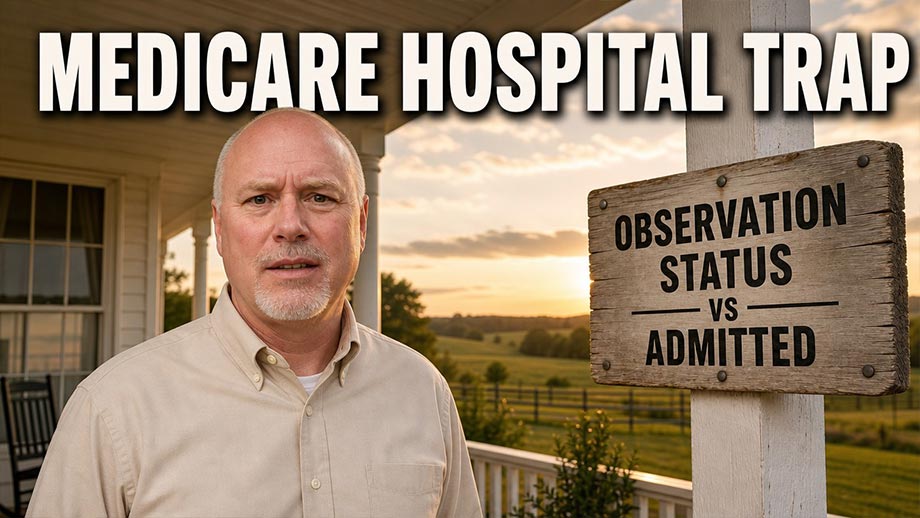
Direct answer: Plan G significantly reduces your financial exposure in both scenarios, but the underlying Medicare classification — observation versus full inpatient admission — still determines which Medicare part covers your care, and that distinction drives real differences in what you’re responsible for even with Plan G in place. Under a full admission, Plan G typically brings your hospital stay to no residual cost beyond any unmet Part B deductible. Under observation, Plan G eliminates your coinsurance exposure but doesn’t erase the Part B deductible, and — critically — it can’t fix the biggest hidden risk of observation status: potential loss of skilled nursing facility coverage afterward.
Medicare classifies hospital stays based on a formal doctor’s order, not on how long you actually stay or what kind of room you’re in.
Full inpatient admission: A doctor formally orders your admission as an inpatient. This typically applies when care is expected to span at least two midnights — the federal “Two-Midnight Rule,” a real, current CMS standard for determining when inpatient admission is appropriate for Part A payment. Coverage falls under Medicare Part A.
Observation status: You remain classified as an outpatient. The hospital provides short-term treatment, testing, and monitoring while deciding whether to admit you or send you home. You can spend one or more nights in a hospital bed and still be classified as outpatient the entire time. Coverage falls under Medicare Part B.
Hospitals are required to provide a Medicare Outpatient Observation Notice (MOON) if you receive observation services for more than 24 hours, explaining your outpatient status and its potential impact on costs and follow-up care.
Inpatient (Part A focus): You’re responsible for the Part A deductible per benefit period, after which Medicare covers 100% of approved hospital costs for the first 60 days. Doctor services and certain other care during the stay fall under Part B separately, subject to the standard Part B deductible and coinsurance.
Observation (Part B focus): No Part A deductible applies at all. Instead, you’re responsible for the annual Part B deductible (if not already met), and then roughly 20% coinsurance on every covered service — labs, imaging, hospital facility fees, and more — with no cap on total Part B costs.
Self-administered drugs — medications you’d normally take yourself, like routine blood pressure or diabetes medications given during the stay — are generally not covered under Part B during observation. The hospital may bill you directly for these, and Part D may help with reimbursement only in limited circumstances.
This is worth understanding clearly: observation can sometimes cost more out of pocket than an inpatient stay of similar length, precisely because the 20% coinsurance compounds across every individual service, while the inpatient deductible is a single, one-time amount for the entire benefit period.
Plan G is standardized and fills nearly every gap Original Medicare leaves open — except the Part B deductible itself, which no Medigap plan covers.
For a full inpatient admission: Plan G pays the entire Part A deductible in full, plus 100% of Part A coinsurance for extended stays. Once you’ve met the Part B deductible, Plan G covers the remaining coinsurance for doctor and outpatient services during the stay too. The result: your hospital stay is typically covered with no out-of-pocket cost beyond any unmet Part B deductible — one of Plan G’s genuine strengths.
For observation status: There’s no Part A deductible for Plan G to cover, since none applies in the first place. You still owe the Part B deductible — Plan G never covers this, regardless of scenario. After that deductible is met, Plan G pays the full remaining Part B coinsurance you’d otherwise owe on facility fees, tests, and covered services. Self-administered drugs remain your responsibility, or may be claimable through Part D in limited cases. The result: your primary cost is generally just the Part B deductible plus any uncovered self-administered drugs — Plan G still shields you from the potentially significant, uncapped 20% coinsurance exposure that would otherwise apply.
In short, Plan G makes both scenarios dramatically more predictable than Original Medicare alone — the inpatient path often ends in no residual hospital cost, and the observation path leaves you responsible mainly for a single deductible rather than open-ended coinsurance.
This is where observation status creates the biggest surprise — one that Plan G, despite its strong coverage elsewhere, genuinely cannot solve.
Medicare Part A covers skilled nursing facility care only after a qualifying three-day inpatient hospital stay. Observation days and emergency room time don’t count toward this requirement, even if you spent the night in a hospital bed. If you need rehabilitation or skilled care following a stay that was classified as observation rather than full admission, Medicare may deny Part A coverage for the skilled nursing facility entirely — and Plan G can’t pay benefits for something Medicare itself doesn’t cover in the first place. You could be facing the full private-pay rate for that care.
If you believe an inpatient admission was medically appropriate — particularly if your status was changed from inpatient to observation during your stay — you may have appeal rights to pursue, rather than accepting the classification as final.
Bottom Line
Plan G doesn’t erase the underlying distinction between observation and inpatient status — those Medicare rules apply regardless of your supplemental coverage — but it dramatically reduces your financial exposure in both scenarios: no Part A deductible burden on inpatient stays, and no open-ended 20% coinsurance exposure during observation. What remains — the Part B deductible, potential self-administered drug costs, and the real risk of non-qualifying skilled nursing coverage after an observation stay — is far more manageable than facing Original Medicare’s gaps alone, but it’s not zero. Hospital status decisions are medical judgments with real financial consequences attached, and knowing the difference — with Plan G in place — means fewer surprises when the bills arrive.
Key Takeaways
Does Plan G cover the difference between observation and inpatient status?
It significantly reduces your costs in both scenarios, but it doesn’t change the underlying Medicare classification or its consequences — particularly for skilled nursing facility eligibility.
What do I pay under Plan G for a full inpatient admission?
Generally nothing beyond any unmet Part B deductible — Plan G covers the full Part A deductible and coinsurance.
What do I pay under Plan G during observation status?
Generally the Part B deductible plus any self-administered drug costs — Plan G covers the remaining Part B coinsurance that would otherwise apply.
Does observation status affect skilled nursing facility coverage?
Yes, significantly. Observation days don’t count toward the three-day inpatient stay Medicare generally requires before covering skilled nursing care, even with Plan G in place.
How do I know if I’m classified as inpatient or under observation?
Ask your care team directly and get the answer in writing if possible — don’t assume based on how long you’re staying or what kind of room you’re in.
Can I appeal if my status was changed from inpatient to observation?
Potentially, yes, especially if you believe inpatient admission was medically appropriate — keep records and raise this with your care team and hospital case manager.
By submitting your information, you agree that a licensed insurance agent may contact you by phone or email to answer your questions or provide additional information about Medicare Advantage or Prescription Drug Plans or Medicare Supplement Insurance plans. This is an advertisement for insurance.
Privacy Policy

We do not offer every plan available in your area. Currently we represent six organizations offering thirty products in your area. Please contact Medicare.gov, 1-800-MEDICARE, or your local State Health Insurance Program (SHIP) to get information on all of your options.
Not connected with or endorsed by the United States government or the federal Medicare program.
HEARTWISE, a Senior Health Services affiliate
Copyright © 2026 HEARTWISE, LLC | Privacy Policy