
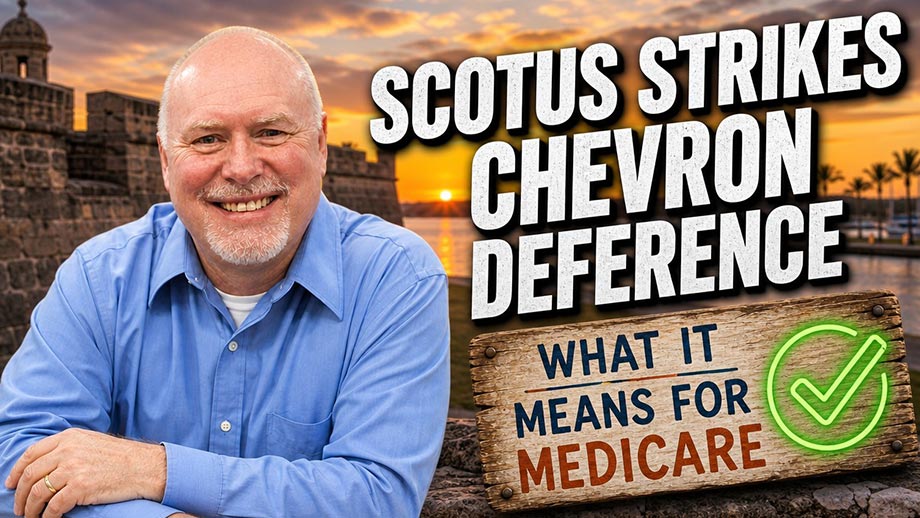
Direct answer: In Loper Bright Enterprises v. Raimondo, the Supreme Court overturned the Chevron doctrine — a roughly four-decade-old legal principle that required courts to defer to federal agencies’ reasonable interpretations of ambiguous statutes. For Medicare specifically, this means courts reviewing CMS’s interpretation of ambiguous Medicare statutes no longer automatically defer to the agency’s expertise; judges now exercise independent judgment instead. The decision generated real predictions of a coming wave of Medicare-related litigation and regulatory disruption — but the actual first-year evidence tells a more modest story than those predictions suggested.
Chevron originated from a Supreme Court case involving the EPA’s interpretation of the Clean Air Act, and it established a two-step test for reviewing agency interpretations of ambiguous laws:
This framework shaped decades of how courts reviewed decisions from agencies like CMS, generally giving those agencies real latitude to interpret gray areas in Medicare law.
What Did the Supreme Court Actually Decide?
By a 6-3 vote, the majority held that courts, not agencies, must have the final word on interpreting ambiguous statutory language — reasoning that the Constitution and the Administrative Procedure Act both require judges to exercise independent legal judgment rather than defer to agency interpretation simply because a law is ambiguous. The majority emphasized a clear separation between lawmaking (Congress) and law interpretation (courts), and noted that agency expertise can still be persuasive to a court, just not automatically controlling.
The dissenting justices argued the opposite: that Chevron deference gave agencies necessary flexibility to adapt to complex, evolving, and highly technical areas — healthcare regulation very much included — and that removing that deference could slow agencies’ ability to respond to emerging issues while inviting a surge of destabilizing litigation.
Both perspectives reflect genuine, ongoing disagreement about the proper balance between judicial and agency authority — this remains a live debate, not a settled question of who was “right.”
Has This Actually Changed How Medicare Regulations Are Enforced?
This is where the real evidence, now that time has passed, is more measured than the original predictions suggested. Research examining the first year of health-related litigation following the ruling found that health agency cases made up only a modest fraction of the total litigation citing the decision — far short of the “seismic shift” some commentators anticipated. This doesn’t mean nothing changed; it means the disruption has been more incremental and case-specific than sweeping.
That said, real Medicare-specific cases have emerged. In one notable example, a federal appeals court overturned a lower court’s decision that had upheld CMS’s interpretation of a Medicare statute — specifically because the lower court had relied on the now-defunct Chevron deference standard to reach its conclusion. Cases like this show the doctrine’s end genuinely can change outcomes in specific disputes, particularly ones already working through the courts when the ruling came down.
A few practical implications worth understanding, while keeping in mind this is still an evolving area:
Bottom Line
The end of Chevron deference is a genuine, significant shift in how courts review CMS’s interpretation of ambiguous Medicare statutes, and it has already produced concrete, case-specific outcomes. But the sweeping disruption some predicted in the immediate aftermath hasn’t materialized at the scale initially expected — the real effect so far has been more incremental, showing up in specific legal disputes rather than broad regulatory upheaval. This remains a genuinely developing area of administrative law worth watching, particularly for how it continues to shape Medicare payment and coverage disputes over time.
Key Takeaways
What was the Chevron doctrine?
A legal principle requiring courts to defer to federal agencies’ reasonable interpretations of ambiguous statutes, in place for roughly four decades before being overturned.
How does the end of Chevron deference affect Medicare?
Courts reviewing CMS’s interpretation of ambiguous Medicare statutes no longer automatically defer to the agency — judges now exercise independent judgment, though agency reasoning can still be persuasive.
Has ending Chevron deference caused a wave of Medicare litigation?
Not as dramatically as initially predicted. First-year research found health agency litigation citing the decision was a relatively modest portion of overall litigation, though specific Medicare cases have been affected.
Are existing Medicare regulations now invalid because of this ruling?
No. The Supreme Court explicitly stated that outcomes in cases already decided under the old Chevron framework remain valid.
Does this mean CMS will lose more legal challenges going forward?
Not automatically. Courts can still find CMS’s interpretations persuasive and uphold them — the difference is agencies must now earn that outcome through reasoning rather than receiving automatic deference.

By submitting your information, you agree that a licensed insurance agent may contact you by phone or email to answer your questions or provide additional information about Medicare Advantage or Prescription Drug Plans or Medicare Supplement Insurance plans. This is an advertisement for insurance.
Privacy Policy

We do not offer every plan available in your area. Currently we represent six organizations offering thirty products in your area. Please contact Medicare.gov, 1-800-MEDICARE, or your local State Health Insurance Program (SHIP) to get information on all of your options.
Not connected with or endorsed by the United States government or the federal Medicare program.
HEARTWISE, a Senior Health Services affiliate
Copyright © 2026 HEARTWISE, LLC | Privacy Policy